
Candidates Are Using AI to Cheat Interviews. Companies Are Quietly Losing the Arms Race.
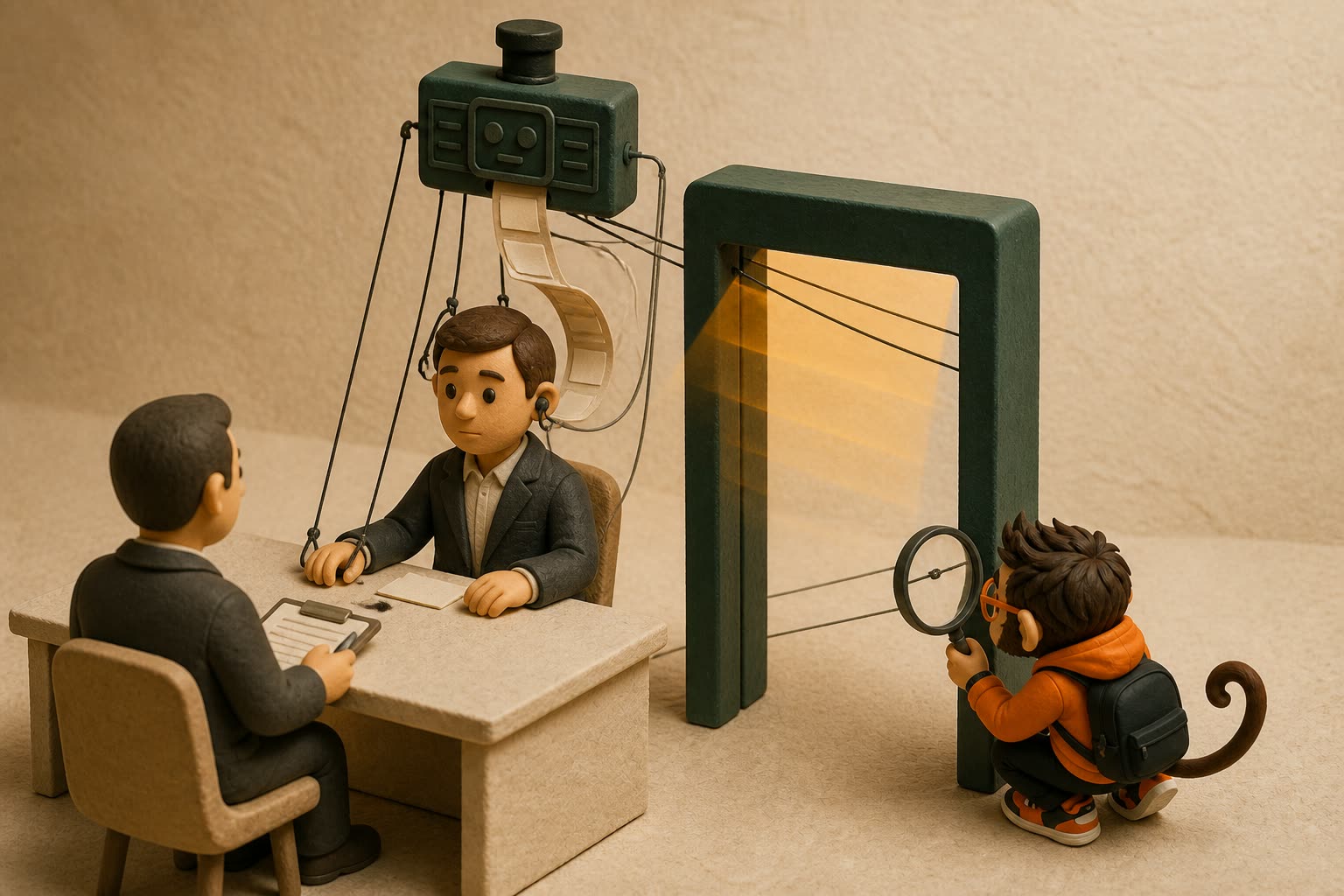
The remote technical screen is broken, and the people running it mostly know. Real-time AI assistants now whisper answers into live interviews, detection catches a fraction of them, and the only reliable response left is to put a body in a room. That last move is the tell. When the verification of choice reverts to "show up in person," the digital filter has already lost.
Here's what most people get wrong about this. They think the story is a few desperate candidates gaming a screen. It isn't. The driver is structural: the cost of cheating collapsed to near zero, the willingness was always there, and the systems built to detect it were never as good as the systems built to defeat them. When a tool advertises 100% undetectable real-time assistance during actual interviews on its homepage, the asymmetry isn't a secret. It's a sales pitch.
How common is using AI to cheat in job interviews, really?
Common enough that it's stopped being deviant and started being normal. That's not hyperbole. It's what the people doing it say about themselves.
In a survey of 3,617 verified professionals, 20% admitted they have secretly used AI during job interviews, and a majority, 55%, agreed that "using AI during interviews has become the new norm." That's self-report, which usually undercounts. The respondents named the companies where it's happening, including Apple, Uber, Tesla, and Bloomberg. This isn't a fringe of bootcamp grads. It's people inside the most selective hiring pipelines in tech.
The willingness number is even starker. One interview-integrity vendor found that 83% of candidates say they would use AI assistance if they thought they could get away with it. Read that as the ceiling, not the floor. The only thing standing between four out of five candidates and an AI copilot is the belief that they'd be caught. Erode that belief and the behavior follows. The tools are eroding it on purpose.
So when you ask how common this is, the honest answer is: it's the baseline assumption now, not the exception. The interviewer across the table is increasingly running their process as if you might be cheating, because one in five of the people before you was.
Why is detection failing so badly?
Because the people building detection and the people building evasion are not playing a fair game. One side ships a feature and waits. The other side ships a counter-feature every few weeks. The defender always moves second.
The managers themselves admit the gap. In a survey of 3,000 U.S. hiring managers, 62% agreed job seekers are now better at faking identities with AI than hiring teams are at detecting them, and only 19% were extremely confident their process would catch a fraudulent applicant. Sit with that second number. Four out of five hiring managers are not confident their own screen works. The same survey found 59% have suspected a candidate of using AI to misrepresent themselves, and 35% reported a virtual interview where someone other than the listed applicant participated. The detection problem isn't theoretical. It's a measured failure rate that employers are reporting on themselves.
The trajectory is what should worry anyone defending a remote screen. Across 19,368 interviews analyzed, flagged cheating jumped from 9% in July 2025 to 45% by September 2025. A separate, independent analysis of more than 20,000 interview records found suspicious-behavior flags rose from roughly 28-30% to 55-60% across two phases, nearly doubling. Two different vendors, two different datasets, same direction: up and to the right, fast. And these are flag rates from tools actively trying to catch it. The undetected share is, by definition, the part the flags miss.
This is the same dynamic that makes AI detection tools mostly snake oil. A detector that runs a 3-5% false-positive rate is a detector that, at scale, falsely accuses real candidates while the sophisticated cheaters route around it. You can't run a hiring funnel on a filter that's both leaky and prone to punishing the innocent.
What does the cheating actually look like now?
Not a phone under the desk. A copilot running on the same machine, invisible to the screen-share, feeding answers in real time.
The category leader markets exactly this. One real-time interview assistant claims 10M+ users across 80+ countries and an "Interview Copilot" that "runs quietly in the background during live interviews". The pitch is not "study harder." The pitch is "we will sit the interview with you, invisibly." That's a different product than the cheat sheets of a decade ago. It transcribes the interviewer's question, generates a strong answer, and surfaces it on the candidate's screen while they appear to be thinking. For a behavioral question, it drafts a polished STAR story on the fly. For a coding screen, it solves the problem.
| Screen type | What the AI copilot does | Why remote can't verify |
|---|---|---|
| Live coding screen | Solves the prompt, explains the approach | No way to confirm the keystrokes are the candidate's |
| Behavioral round | Drafts STAR answers in real time from the question | Polished narrative is indistinguishable from preparation |
| Identity / who-is-this | A different person can sit the seat entirely | 35% of managers report a non-applicant joined a virtual interview |
| Take-home assignment | Completes the whole thing unsupervised | The candidate was never observed doing any of it |
That last row is the quiet scandal. The take-home was always the least verifiable format, even before generative AI, which is part of why take-home tests function mostly as unpaid labor rather than a real signal. Now it verifies nothing at all. A take-home in 2026 measures a candidate's ability to paste a prompt into a model. That's it. The format didn't get gamed at the margin. It got hollowed out.
Is this a few cheaters, or a market-wide shift?
A market-wide shift, and the numbers from the demand side confirm it. AI use in hiring is no longer an edge case some candidates exploit. It's the default behavior of the applicant pool.
A Gartner survey of 3,290 candidates found 39% used AI during the application process, including 29% who used it on assessment answers. A separate Gartner survey found 6% admitted to outright interview fraud, posing as someone else or having someone pose for them. Six percent admitting to identity fraud in a screen is a five-alarm number, because admitted fraud is a fraction of attempted fraud. And ZipRecruiter data shows AI-based interview prep usage rose 44% year over year. The whole pool moved.
Gartner's forward call is the one hiring teams are now planning around: by 2028, 1 in 4 candidate profiles worldwide will be fake. For remote roles the present is already worse. A Gartner analyst told Computerworld that clients hiring for remote IT roles "can expect at least half of the applications received on that role to be false." When half your remote applicant pool is potentially fabricated, you are not running a hiring process. You are running a fraud-detection operation that occasionally hires someone.
Why is in-person hiring quietly coming back?
Because it's the one verification that an AI copilot can't sit beside you for. When detection fails, employers stop trying to detect and start trying to witness.
The shift is already in the data. Per Gartner, 72.4% of recruiting leaders reported they are currently conducting interviews in-person to combat fraud, and the same reporting names Google, Cisco, and McKinsey among companies that have re-instituted in-person rounds. This is the contrarian read playing out in real time. The industry spent fifteen years moving interviews online for speed and reach, and it's now reversing that for one reason: a body in a room is the only credential a real-time AI assistant can't forge.
The candidates are quietly fine with it, which is the part that breaks the usual "in-person is friction" assumption. The same Gartner work found 62% of candidates are more likely to apply when in-person interviews are required, and only 26% trust AI to evaluate them fairly. Honest candidates want a process that can't be gamed by the dishonest ones, because in a pool full of cheaters, the cheaters are the competition. In-person verification doesn't just protect the employer. It protects the candidate who actually did the work.
This is why the smarter teams aren't just dragging people back to an office. They're rebuilding the process around what's hard to fake. Structured interviews beat gut-feel precisely because they probe for the lived, specific, follow-up-able detail that a copilot can draft a clean paragraph about but can't defend under three layers of "and then what happened?" The defense against AI isn't a better detector. It's a harder question.
So should you just use the tools too?
Here's the part nobody selling a copilot will tell you. The arms race has a casualty, and on the candidate side, it's you.
Think about what these tools actually buy. A weak version of using them:
You run a copilot through a remote coding screen, it solves the problem, you pass to the onsite, and now you're in a room with a whiteboard and an engineer who asks you to extend the solution you supposedly wrote. You can't, because you didn't. The copilot got you to the exact round where it can't help you, in front of people who now have a reason to doubt everything that came before.
The strong version doesn't involve a copilot at all:
You prep the actual skill, walk into the in-person round, and when they push on your solution you go three layers deeper because it's genuinely yours. The trust you build in that room is the thing the cheater can never manufacture. You're not competing on who has the better tool. You're competing on who can survive contact with a hard follow-up.
The honest trade-off, stated plainly: AI cheating tools are optimized to clear the exact filter that's collapsing. They get you past the remote screen that more and more companies are removing, and they leave you naked at the in-person round that's replacing it. They also carry a tail risk that's getting worse, not better, as detection improves and identity fraud gets prosecuted. The same survey that found detection mostly fails also found 23% of companies reported fraud losses over $50,000, and companies that lose money like that build memories, blacklists, and lawyers.
There's a deeper reason to skip them. The entire premise of an AI copilot is that you're faking a competence you don't have. But confidence is coachable and competence isn't fakeable past the first easy filter. A tool that helps you fake the screen is a tool that guarantees you'll be exposed exactly when the stakes are highest, in the room, in the job, on the first real task. The move that actually compounds is building the thing the copilot only pretends you have.
Who does this leave out? Honest candidates competing against cheaters in remote pools, who lose slots to faked screens through no fault of their own, and who should weight their applications toward employers running in-person or structured rounds where their real skill counts. And candidates with genuine reasons to prefer remote, including disability and caregiving constraints, who get caught in the backlash against a process other people abused. That's the real cost of the arms race. It's not paid by the cheaters. It's paid by everyone who has to share a funnel with them.
What to do now
- Assume the remote screen is on its way out, and prep for the room. Build the underlying skill, not the screen-passing trick. The format that survives this is the one that watches you work.
- Prefer employers running structured, in-person, or live-defended rounds. They reward real competence and penalize the fakery you're competing against. That asymmetry works in your favor when you've actually done the work.
- Practice the hard follow-up, not just the first answer. The copilot drafts a clean opener. It can't defend it three questions deep. Rehearse going deeper than your prepared line, out loud, until it's reflexive.
- Don't use the undetectable tools. They clear the screen that's disappearing and expose you at the round that's replacing it, with a fraud tail that's getting worse. The math runs against you the moment you reach a real human in a real room.
- Make your genuine work legible. Concrete, specific, follow-up-able stories from things you actually did are the one credential a real-time assistant can't forge under pressure.
Want to walk into the in-person round able to defend every answer three layers deep, instead of hoping a copilot carries you to where it can't? That's exactly what I'm built for. Message me on WhatsApp and we'll drill your real stories, rehearse the hard follow-ups, and prep the skill that survives contact with a sharp interviewer.
Related reading
Structured vs Unstructured Interviews: The Gut Feeling Predicts Least
A gut-feel chat explains about 4% of job performance. Structured vs unstructured interviews: what nearly 40 years of research shows, and how to win both.
Interviews Reward Confidence Over Competence. Here's How to Stop Losing to It.
Interviews reward confidence over competence because fluency is a proxy for skill. Here's how to make your real ability legible and stop losing rooms.
They Can't Reliably Detect Your AI Writing. They Can Tell It's Generic.
AI detection on a job application is mostly broken. The real filter is a recruiter spotting generic in 20 seconds. Here's what actually gets you read.
Weaknesses for Job Interviews: 12 Real Answers, Not Humblebrags
In an HBS study, 77% of students humblebragged about their weakness, and raters preferred the honest ones. 12 weaknesses for job interviews, with answers.