They Can't Reliably Detect Your AI Writing. They Can Tell It's Generic.
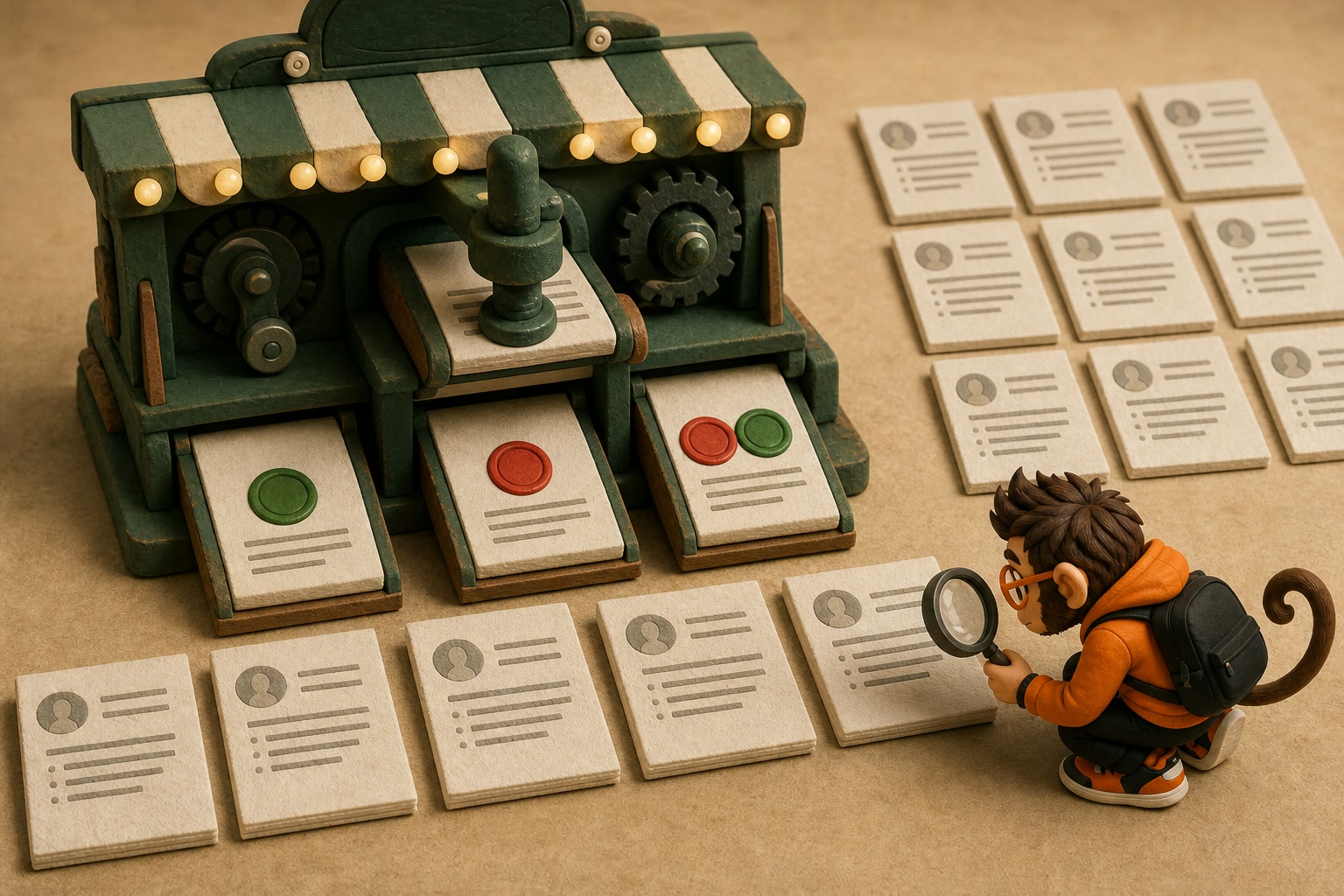
No serious hiring process is running your cover letter through an AI detector and rejecting you on the score. The tools can't do it reliably: they catch a fraction of real AI text and falsely accuse human writers. The thing that actually sinks your application is older and faster: a recruiter reads the first sentence, feels nothing, and moves on. Generic is the tell, not AI.
So you're solving the wrong problem. People spend thirty minutes rephrasing a cover letter to drop its "AI score" from 87% to 12%, then send something that could have been mailed to any company in the industry. They beat a tool that wasn't going to catch them and lost the human who was always going to. That human is usually the hiring manager, the one reader a cover letter is really written for.
Can AI detectors actually tell if a job application was written by AI?
Mostly, no. The clearest evidence is that OpenAI killed its own detector. In July 2023 the company that builds the models pulled its AI Classifier "due to its low rate of accuracy". By OpenAI's own published numbers, the tool correctly flagged just 26% of AI-written text as "likely AI," while wrongly flagging 9% of human writing as machine-made. If the people with the most to gain from working detection couldn't make it work, that tells you where the field sits.
Independent research is no kinder. One study put unmanipulated AI-content detection at 39.5% accuracy, and after basic evasion (a few spelling errors, varied sentence length) it fell to 22.14%, with a 15% false-accusation rate on genuine human writing. University of Pennsylvania researchers found that homoglyph attacks alone cut detector performance by about 30%. A detector that a deliberate typo defeats is not a gate. It's theater.
Why do AI detectors flag human writing as AI?
Because they were built on a flawed premise: that "predictable" text is machine text. Writing that uses common words in common patterns scores as AI. The problem is that a lot of careful human writing looks exactly like that, especially from people writing in a second language.
The Stanford finding here is the one to sit with. Researchers ran TOEFL essays, all written by human non-native English speakers, through seven detectors. The detectors flagged 61% of them as AI-generated, and roughly one in five essays was unanimously misclassified by every tool. These were real people, writing carefully, in a language not their first. The tool read clean, simple sentence structure and called it a machine.
Think about what that means in hiring. An international candidate writes a careful application. A detector tags it 61%-likely AI. If the employer has any automated screen wired to that score, a qualified human never gets read. That isn't a story about AI writing. It's a broken tool penalizing the people who already had the steepest climb.
How do recruiters actually screen applications, then?
By reading fast and reading for specifics. They are not forensic analysts. They are people with a stack of 200 applications and an afternoon. 36% of hiring managers spend under 30 seconds reading a cover letter, which is the same brutal arithmetic behind the seven-second resume scan that is very much real. In an IEEE-USA survey, 33.5% said they can flag an AI-generated resume in under 20 seconds, not because software told them, but because they've read the same shape a hundred times this month.
This is the part worth internalizing. When a recruiter says "I can tell it's AI," they usually mean "I can tell it's generic." 88% of hiring managers in one survey claimed they can spot AI use, and 54% said they'd care. Take the 88% with salt: it's self-reported confidence, not tested accuracy, and human readers carry the same bias the detectors do (they'll misread a careful non-native writer as "AI" too). But the underlying behavior is real and it's the one that decides your application. They're pattern-matching against sameness. And 78% of hiring managers say they can easily tell when an applicant has invested time into tailoring the application. Specific reads as human. Generic reads as spam. The detector verdict barely enters the room.
Why has "generic" become so much more dangerous than it used to be?
Because the floor moved. In 2022, a competent, polished application stood out. Now everyone has a tool that produces competent and polished in ten seconds, so the market is flooded with it. This is the same dynamic where AI resume tools didn't make you better, they made everyone identical: when the whole pool sounds the same, polish stops being a signal. LinkedIn saw a 45% year-over-year surge in job applications. More people, the same roles, and most of the new volume sounds identical.
Recruiters feel it. 90% of HR workers report a rise in low-effort, spammy AI applications, and 64% of recruiters say the wave of look-alike applications has actually increased their screening workload. Some of that sameness comes from auto-apply tools blasting 200 identical submissions, which is a behavior problem, not a prose problem. But the effect on you is the same either way. "Results-driven professional with a passion for innovation and a proven track record of delivering excellence" used to be filler. Now it's camouflage. It makes you disappear into the 300 other people who submitted the same sentence. 62% of HR workers say AI resumes without customization are more likely to be rejected. Polish is table stakes. Specificity is the only thing left that separates you.
What does specific actually look like, next to generic?
Here's the difference, side by side. Same candidate, same qualifications. One version is invisible. One starts a conversation.
| Generic (invisible) | Specific (memorable) | |
|---|---|---|
| Self-description | "Results-driven professional with a passion for innovation and a proven track record of delivering excellence." | "In my last role I cut onboarding time from 14 days to 4 by rebuilding the internal wiki. You listed knowledge management as a 2025 priority, and I want to do that at scale." |
| Cover letter opener | "I am writing to express my strong interest in the Software Engineer role at your esteemed organization." | "I've followed Praxy since the WhatsApp integration launched. A career copilot that meets people where they already talk is the exact problem I spent two years on at my last company." |
| Resume bullet | "Responsible for managing key projects and driving cross-functional collaboration." | "Led the migration of 40 microservices to a single deployment pipeline, cutting release time from 2 days to 3 hours." |
Look at what the strong column has that the weak one can't fake: a real number, a real project, and a sentence that could only be written by this person about this company. The weak versions pass any grammar check. They also pass straight out of the recruiter's memory.
The test is brutal and it's one question: could any qualified person have sent this exact line to any company in this industry? If yes, it's generic, no matter how clean it reads.
So what's the actual fix, if it isn't evasion?
Add back the thing you can't outsource. AI is a fine drafting tool. Use it to fix your grammar, tighten a clunky paragraph, get past the blank page. That's legitimate, and most tech hiring managers treat it as such. The mistake isn't using AI for the prose. The mistake is letting it write the substance, because substance is the only part that was ever going to get you read.
What substance looks like, concretely:
One number from your own work. Not "improved efficiency." The 14-to-4-days number. The 40 microservices number. Whatever yours is.
One sentence about them, specifically. A priority from their job post, a recent launch, a problem you know they have. Ten minutes of homework that the auto-applier next to you didn't do.
One line of why you, for this. Not why you want a job. Why your specific story maps to their specific need.
Three sentences only you could write will beat a flawless letter that anyone could. This is the Praxy frame on every part of a career: the boring, repeatable, specific move beats the heroic polish. You don't need a better tool. You need to put yourself back into the document.
What this costs you
Honestly: time. Specificity doesn't scale. You cannot send a genuinely tailored application to 200 roles in an afternoon, and that's the trade. You'll apply to fewer jobs and spend longer on each, which is exactly why applying to 300 jobs is a symptom, not a strategy. The math still works, because a customized application clears the bar that gets uncustomized AI resumes rejected, and ten targeted applications that get read beat 200 that get pattern-matched into the trash in 20 seconds.
One more honest note, looking forward: detection is broken today, but it may not be in 2028. (Live interviews have the same problem: AI cheating in interviews is outrunning detection.) Provenance standards like C2PA and watermarking rules under the EU AI Act are coming. The advice doesn't change when they arrive, though. Specific, evidenced, human writing wins in a world with working detectors and in a world without them. You're building the right habit either way.
What to do now
- Pick one application you're about to send. Not your whole backlog, just one, so you actually do this today instead of someday.
- Run the "could anyone have sent this" test on every line. If a sentence would work for any qualified candidate at any company in your industry, cut it.
- Add one number from your own work. Not "improved efficiency." The 14-to-4-days number, the 40-microservices number, whatever yours is.
- Add one sentence about them, specifically. A priority from their job post, a recent launch, a problem you know they have.
- Add one line of why you, for this. Not why you want a job. Why your specific story maps to their specific need.
- Stop running your draft through a detector, and start reading it like the recruiter will. They have 199 other applications to get through this afternoon.
The arms race over AI scores is a race you don't need to run. Skip it and go win the thing that was always the actual contest.
Want a second read before you hit send? Message Praxy on WhatsApp with the job post and your draft. I'll tell you, plainly, where it sounds like everyone else and exactly what to swap in so a recruiter remembers you.
Related reading
AI Resume Tools Didn't Make You Better. They Made Everyone Identical.
An AI resume builder polishes your application into the same shape as everyone else's. Here's why specificity is the only signal left, and how to find yours.
ChatGPT Resume: 7 Prompts That Work (Use It as an Editor, Not an Author)
A ChatGPT resume works when you feed it facts and make it edit, not write. Here are 7 copy-paste prompts, what it gets wrong, and whether employers care.
Candidates Are Using AI to Cheat Interviews. Companies Are Quietly Losing the Arms Race.
Using AI to cheat in job interviews is now common: 1 in 5 professionals admit it and only 19% of managers trust their screen. Why the remote era is ending.
Is a Cover Letter Necessary? Only for the Person Who Decides
Is a cover letter necessary? Recruiters mostly skip it, but 94% of hiring managers say it sways who gets interviewed. Here's when to send one, and when not.