
Structured vs Unstructured Interviews: The Gut Feeling Predicts Least
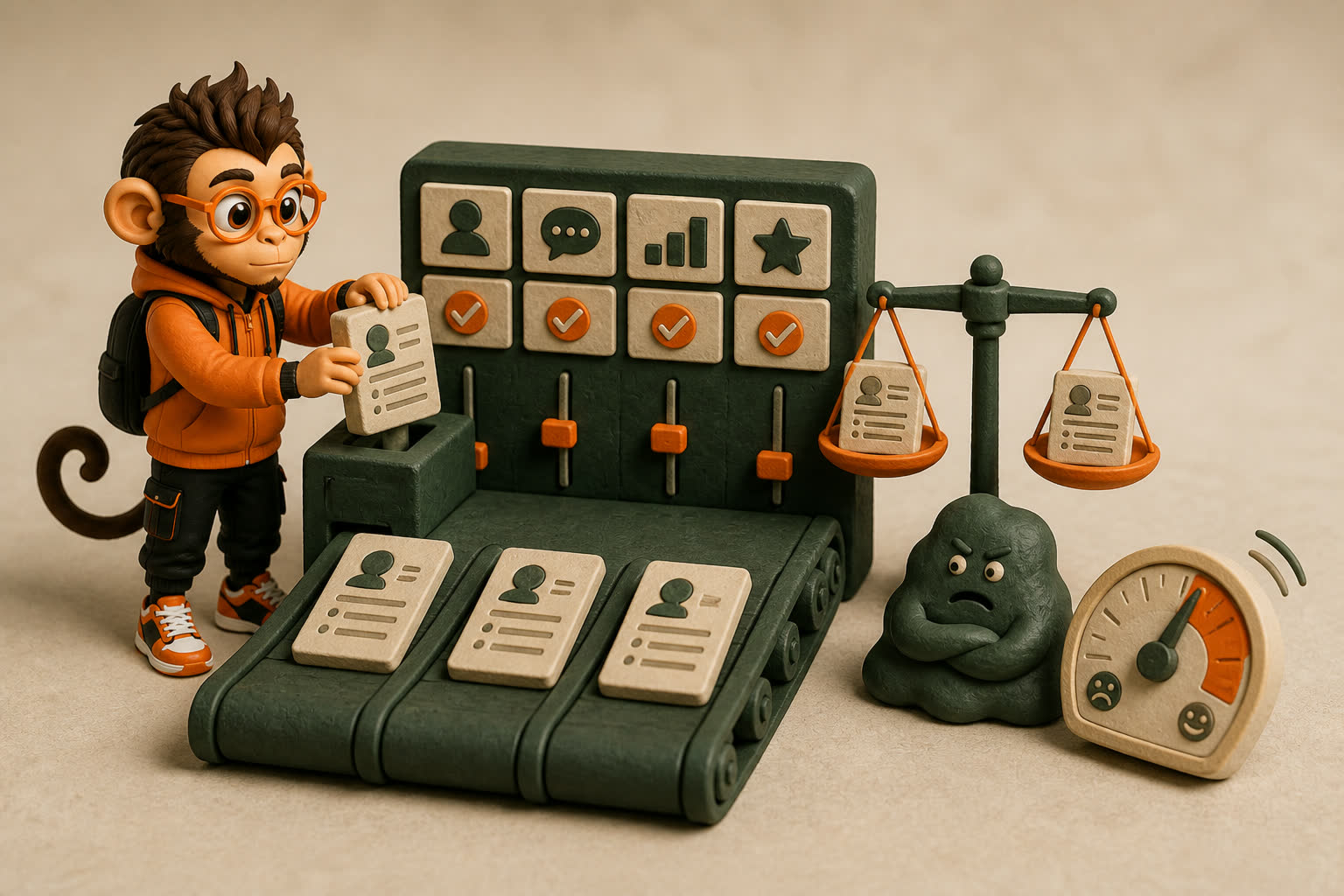
Structured interviews predict job performance far better than unstructured interviews, and the gap has held for almost 40 years of research. The relaxed, conversational interview where someone decides if they "click" with you is one of the weakest hiring tools ever measured. In Sackett and colleagues' 2022 reanalysis, an unstructured interview's estimated validity is about .19. Square that and you get the variance it explains in actual job performance: roughly 4%. Almost everything else in that room is noise.
Here's how the main methods rank in that 2022 reanalysis. The last column is just the validity squared: the share of differences in job performance each method accounts for.
| Method | Validity (Sackett et al. 2022) | Performance variance explained |
|---|---|---|
| Structured interview (same questions, scored on a rubric) | .42 | about 18% |
| Work sample test | .33 | about 11% |
| General mental ability test | .31 | about 10% |
| Unstructured interview (the open chat) | about .19 | about 4% |
Here's the part nobody tells you. The interviewer can't fix this, and most won't try. So you have to. The less structured the interview, the more structure you have to bring yourself. Chaos protects the person running on instinct. It punishes the candidate who has the substance but not the polish to make it legible.
How much do unstructured interviews actually predict?
Almost nothing you'd bet money on. The .19 validity estimate from Sackett et al. 2022 means the freewheeling chat explains around 4% of the difference in how people perform once hired. The other 96% is everything the conversation didn't measure and the interviewer's mood did.
Compare that to a structured work-sample test, which the same 2022 reanalysis puts around .33. Square it and you get about 11% of variance explained. More than double the gut chat, from a method that just asks you to do a slice of the actual job.
So the most-used tool is near the bottom of the toolkit. People keep reaching for it because it feels true. Feeling true and being predictive are different things, and the gap between them is where good candidates get lost.
The research has said this for close to 40 years. This isn't a hot take. It's settled.
Wiesner and Cronshaw's 1988 meta-analysis pooled 150 validity coefficients and found structured interviews hit a corrected validity of .63 against .20 for unstructured. Structure roughly tripled the predictive power. That was the first loud signal.
Schmidt and Hunter's 1998 review, the most-cited paper in the field, set the baseline most people still quote: structured interviews around .51 and work samples around .54, both well above unstructured interviews.
Then the numbers got honest. Sackett et al. 2022 corrected a long-standing statistical overcorrection and revised the estimates down across the board: structured interviews to .42, work samples to .33, general mental ability to .31, with unstructured interviews near .19. The headline figures shrank. The ranking didn't. Structured still beats unstructured by a wide margin, in every reading of the data, across every decade.
Why is your brain the problem?
Because it decides fast and then spends the rest of the hour confirming the decision instead of testing it.
Ambady and Rosenthal's 1993 study is the famous one. They showed people silent video clips of teachers just a few seconds long. Those snap judgments predicted end-of-semester student evaluations with striking accuracy, and longer clips didn't meaningfully improve the read. Humans form a stable impression in seconds.
That cuts both ways. The thin slice is fast, sometimes accurate, and completely unauditable. Once an interviewer has formed it, the rest of the conversation stops being evidence-gathering and starts being evidence-filtering. Your strong answer gets read as expected. Your weak moment gets read as the real you. The interviewer isn't evaluating you against the job. They're checking whether your story matches the story they wrote about you in the first four minutes.
What about bias toward people who look like the interviewer?
It's real, it's documented, and the unstructured format makes it worse.
The "like me" effect shows up across shared background, schools, values, and communication style. When the format has no rubric, there's nothing to anchor the judgment except how comfortable the interviewer feels. Comfort tracks familiarity. Familiarity tracks similarity. So the candidate who reminds the interviewer of themselves gets a tailwind, and the candidate who doesn't is fighting a headwind that nobody in the room can see or name. This is the same machinery that lets the unspoken "would I want to grab a beer with this person" test quietly outweigh competence, and the reason the warm-sounding "culture fit" verdict so often turns out to be bias wearing a nicer name.
Structure suppresses this. When every candidate answers the same questions scored on the same scale, there's less room for "I just had a better feeling about her." That's not a diversity nicety. It's the same mechanism that makes the interview more predictive in the first place: it forces the decision onto evidence and off vibes.
What's the difference between a structured and unstructured interview?
This is where it gets concrete. Same person, two formats, two outcomes.
| The vibe interview | The structured interview | |
|---|---|---|
| Setup | 30-minute open chat with a hiring manager | Same questions, scored on a rubric, for every candidate |
| What gets measured | Rapport, polish, how nervous you seem | "Tell me about a time you solved a problem with limited resources" |
| First-gen grad who stutters when nervous | Dinged. Read as "not confident," "not a fit" | Aces it. The accomplishments are unambiguous once elicited |
| Polished candidate, recognizable school, thin track record | Sails through three rounds on rapport | Exposed. Has one real example where the job needs three |
The vibe interview rewards the second person and loses the first. The structured one surfaces what each actually did. Google made this exact correction when it dropped brainteasers like "how many golf balls fit in a school bus." As its then head of people operations, Laszlo Bock, told the New York Times, "brainteasers are a complete waste of time. They don't predict anything," after Google's own data showed near-zero correlation with on-the-job performance. The puzzle felt like signal. It wasn't. Most "culture fit" final rounds are the same trap wearing a friendlier face.
What actually predicts performance?
Evidence of the work, scored consistently. Not charisma.
The ranking is stable across every major review. Work samples and structured interviews sit at the top, and they're the formats that hold up best as candidates use AI to cheat remote interviews. Gut conversations sit near the bottom. And how the evidence gets combined matters as much as what you collect. Grove and colleagues' 2000 meta-analysis found mechanical prediction (adding up the scores by a rule) was about 10% more accurate on average than clinical prediction (an expert weighing it in their head), and substantially better in 33 to 47% of studies. The expert's holistic judgment won substantially in only 6 to 16%. Kuncel et al. 2013 found the same: combining the same data by gut instead of by formula loses validity, consistently, across work and academic settings.
Google ran the numbers too. Its People Analytics team studied five years of interview data and found that four interviews predicted a qualified hire with about 86% confidence, with returns flattening after that. More rounds mostly added time, not accuracy. And its structured-interviewing research found a second payoff: rejected candidates who went through a structured process reported 35% higher satisfaction. Fair and legible doesn't just predict better. It feels better even when you lose.
How do you answer well in an unstructured interview?
You can't make them use a rubric. But you can give your answers rubric shape.
A gut-feel interviewer is pattern-matching for evidence of competence whether they know it or not. So hand it to them in the shape their brain is hunting for. STAR framing (situation, task, action, result) isn't a trick. It forces you to give the concrete evidence the interviewer is actually trying to find, before their first impression hardens into the only thing they remember.
Weak: "I'm really collaborative and I work well under pressure. People say I'm easy to work with."
Strong: "Last year our launch slipped two weeks out. I pulled the three teams into one daily 15-minute sync, cut scope to the two features that mattered, and we shipped on the original date. Retention held. That's how I work under pressure: triage, then commit."
The strong version is the same person. It just refuses to leave the interpreting to a stranger's mood, which is also how you stop losing rooms to candidates whose confidence reads as competence even when the substance isn't there. The mid-career PM walking into a founder panel that hires on instinct doesn't try to out-charm them. She opens with a tight walk-through of one past product decision, a work sample in disguise, and anchors the whole conversation to evidence the panel didn't think to ask for. She imposed the structure they wouldn't.
This is the Praxy worldview applied to a single hour: agency over fatalism. The room is biased. The bias is documented. That makes it a known headwind you can steer into, not a verdict you have to accept.
What does this cost, and where could it backfire?
Honesty time. Three things cut against the clean version of this argument.
First, thin slices aren't always wrong. Ambady and Rosenthal showed snap reads can be genuinely accurate. The problem isn't that gut feelings are always false. It's that they're inconsistently right, impossible to audit, and biased in ways that track things which have nothing to do with the job.
Second, structure can be theater. A "structured" interview with generic questions, informal scoring, and untrained interviewers is just a vibe chat with a worksheet. Structure is necessary for better prediction. It isn't sufficient.
Third, the expert sometimes knows what the rubric can't. A seasoned engineering manager can catch an architectural misconception in a live discussion that no test yet captures, especially for senior roles. The honest argument was never "delete human judgment." It's constrain it and feed it better evidence. And the 2022 downward revision cuts both ways too: if structured interviews are really closer to .42 than .51, the gap over unstructured is narrower than the old numbers implied. Still real. Still worth playing for. Just not a chasm.
What to do now
Stop trying to be the most likable person they meet today. Aim to be the most legible. Four moves before your next interview:
- Write three STAR stories cold. One on a hard result, one on a conflict, one on a failure you learned from. Each ends with a number or a concrete outcome, not an adjective.
- Bring a work sample they didn't ask for. A two-page teardown, a past decision walk-through, a short plan for their actual problem. Anchor the conversation to evidence before the first impression sets.
- Assume lock-in by minute five. Your strongest signal goes early, not saved for a big finish that may never get a fair hearing.
- Turn every adjective into a result. If you hear yourself say "collaborative" or "good under pressure," follow it with the time you proved it, the way the strong version above does.
You don't need them to run a better process. You need your answers to survive the one they're running.
Want to pressure-test your weakest answer before it costs you the offer? Message Praxy on WhatsApp and we'll run a mock interview that makes your real competence impossible to misread.
Related reading
Weaknesses for Job Interviews: 12 Real Answers, Not Humblebrags
In an HBS study, 77% of students humblebragged about their weakness, and raters preferred the honest ones. 12 weaknesses for job interviews, with answers.
Candidates Are Using AI to Cheat Interviews. Companies Are Quietly Losing the Arms Race.
Using AI to cheat in job interviews is now common: 1 in 5 professionals admit it and only 19% of managers trust their screen. Why the remote era is ending.
"Culture Fit" Is Where Discrimination Hides in Plain Sight
Culture fit is often rejection on vibes with a professional disguise: the research, the legal risk, and how to protect yourself as a candidate.
Interviews Reward Confidence Over Competence. Here's How to Stop Losing to It.
Interviews reward confidence over competence because fluency is a proxy for skill. Here's how to make your real ability legible and stop losing rooms.