
'Tell Me About Yourself' Isn't a Warmup. It's the Whole Interview in Disguise.
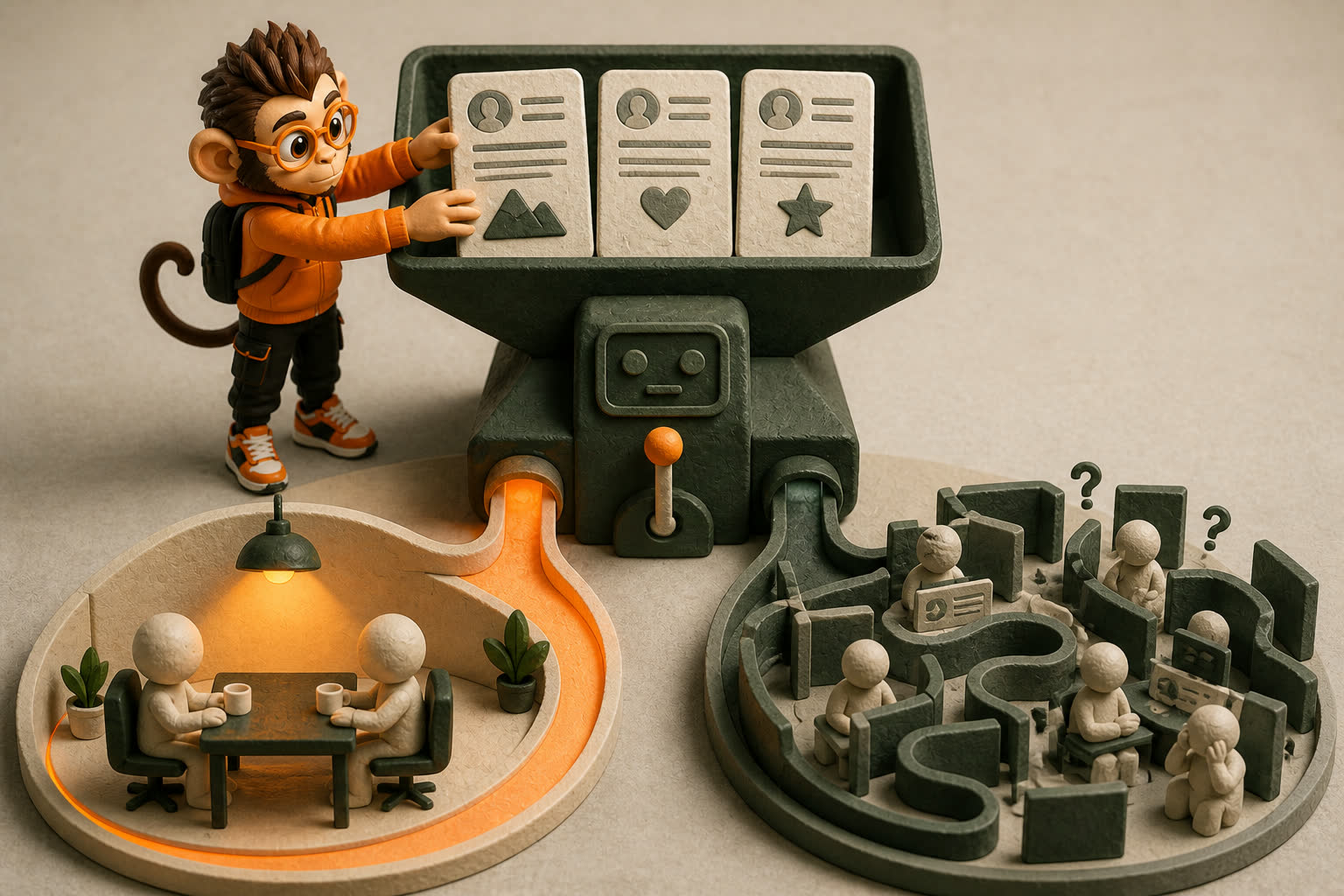
The least-prepared question in your interview is the one that decides it. Everyone treats "tell me about yourself" as the polite throat-clearing before the real questions start, so they wing it. That's the mistake. The opener is a primacy-effect anchor that biases every judgment the interviewer makes for the next half hour.
Most people believe the interview is scored on the sum of their answers, that a weak start gets washed out by strong middle answers about projects and metrics. The research says the opposite. The impression forms early, locks in fast, and then the interviewer spends the rest of the call confirming it. The loosest question is the highest-leverage one, and you're improvising it.
Is the opener really used to start every interview?
Yes, and that's exactly why it's dangerous. Familiarity breeds contempt for preparation.
It is the single most reliable first move in interviewing. Indeed, one of the highest-traffic career sources on the planet, describes it plainly: "the hiring manager may start the conversation by saying, 'Tell me about yourself.'" It opens the conversation. It is also short. Robert Half advises that a good answer should "aim for between one and two minutes" a two-minute window to frame your experience and motivation.
So you have a 90-second answer, given before you've warmed up, that you treat as filler. And it's the first data the interviewer gets. That combination, low preparation and high position in the sequence, is precisely what makes it the worst-defended part of the whole process.
How fast does a first impression actually lock in?
Faster than you can finish a sentence. Before you've said much of anything, the snap judgment is already made.
The cleanest evidence comes from a study where people saw a stranger's face for one-tenth of a second. Researchers found that trait judgments made after a 100-millisecond exposure correlated highly with judgments made with no time limit. Giving people more time didn't change the impression. It only made them more confident in it. The Association for Psychological Science restates it cleanly: all it takes is a tenth of a second to form an impression of a stranger, and longer looks don't significantly alter it. Trustworthiness showed the strongest correlation between the snap read and the unhurried one.
Read that twice, because it reframes the whole game. The interviewer forms a view of your competence and trustworthiness before you've delivered a single accomplishment. Then everything you say afterward gets filtered through it. A strong opener doesn't just earn you a point. It tilts the lens through which the next twenty minutes are interpreted.
When have interviewers actually made up their minds?
Much earlier than they'd admit, and earlier than you'd hope. Most candidates are still mid-answer when the decision is functionally done.
A study of 166 interviewers evaluating 691 real candidates measured exactly when each interviewer reached a hiring decision. The numbers: 4.9% had decided within the first minute, roughly a quarter within the first five minutes, and 59.9% by minute fifteen (summary here). Nearly six in ten interviewers have decided by the quarter-hour mark. Worth noting honestly: the researchers framed this as evidence that snap-judgment claims are exaggerated — most decisions land after the five-minute mark, not in the first four. The point isn't that the opener seals the deal. It's that a large chunk of interviewers commit while you're still early in the call. In a 30- to 45-minute interview, that means most of your answers are landing after the verdict is in. They're not building the decision. They're being judged against it.
| Point in the interview | Share of interviewers who've decided | What you're usually doing |
|---|---|---|
| First minute | 4.9% | Mid-opener |
| First five minutes | ~25% | Second or third answer |
| First fifteen minutes | 59.9% | Still on background and projects |
The opener sits inside the window where a quarter of interviewers are already locking in. It's the only answer guaranteed to land before anyone has decided. That's not a reason to relax about it. That's the reason it matters most.
Does the opening impression really predict the offer?
It does, and this is the finding that should change how you prepare. The early read doesn't just correlate with liking. It correlates with the hire.
Researchers had interviewers rate candidates after the brief opening rapport, then tracked those candidates through the full structured interview and into actual offers. The early impression correlated r = .42 with end-of-interview ratings and r = .22 with actual internship and job offers. The effect even carried over to a separate interviewer who skipped rapport-building entirely. The first impression wasn't a quirk of one warm interviewer. It traveled.
Now stack that against the clock. In the same study, the opening rapport portion lasted just 2 to 3 minutes, versus the 20- to 25-minute structured interview that followed roughly 10% of the interview's time. Ten percent of the clock, disproportionate weight on the outcome. That's the entire thesis in one statistic: the part you treat as warmup is doing the heavy lifting on the decision, while the part you over-rehearse is mostly confirming a verdict already in motion.
This is also why the opening minutes are where competence gets read before it gets demonstrated. You can't fake the substance later. But you can absolutely lose the substance to a flat, rambling start that sets a low anchor the interviewer never bothers to revise.
What separates a weak opener from a strong one?
A weak opener narrates your resume in chronological order and hands the interviewer nothing to grab. A strong one sets the frame, names a problem you solve, and tees up the questions you want asked.
Weak version: "So, um, I graduated in 2018 with a degree in marketing, then I joined a small agency where I did social media for about two years, then I moved to a bigger company in a more analytics-focused role, and now I'm here because I'm looking for the next step, I guess. Yeah. That's kind of me in a nutshell."
That answer is a timeline. It has no spine, no claim, no signal about what you're good at. The interviewer's snap read fills the vacuum, and it rarely fills it generously.
Strong version: "I turn messy marketing data into decisions. I started agency-side running social, but the part that stuck was the analytics, so I moved into a role where I owned the attribution model and cut wasted ad spend by a third. I'm here because this role is exactly that problem at a bigger scale, the kind of measurement work you mentioned you're trying to build out. Happy to go deeper on any of that."
The difference isn't polish. It's that the second version installs a frame: this is a person who solves the measurement problem we have. Every subsequent question now gets interpreted as evidence for or against that frame, and you've made the frame flattering. You've also seeded the questions you want, which is how a good opener quietly steers the rest of the call. The same way a sharp set of questions you ask the interviewer gets silently scored, your opener sets the agenda before the scoring even starts.
Doesn't this just reward smooth talkers over the actually qualified?
Here's the part the optimistic version skips. Yes, partly, it does. And that's a real cost, not a footnote.
The primacy effect is a bias. It rewards people who present well early, and it can penalize strong candidates who are slow to warm up, anxious openers, non-native speakers handling a high-pressure first answer, or anyone whose strength is depth over first-impression polish. If the system were fair, every answer would weigh the same. It doesn't. The research above is a description of how interviewers actually behave, not an endorsement of it.
There's a reason hiring teams are pushed toward structured interviews that score every answer against a rubric instead of trusting gut feel precisely to blunt this anchor. But you don't control whether your interviewer uses one. Most don't, fully. So the honest move is to play the game in front of you while knowing it's tilted: prepare the opener hard, because the bias is real and it's currently working against the candidates who refuse to.
And know the limit. A great opener buys you a favorable anchor. It does not survive a hollow middle. If the interviewer probes your "cut ad spend by a third" claim and you can't explain how, the anchor flips fast, and a strong start makes the fall steeper. The opener is leverage on real substance, not a substitute for it. There's also a flavor of this that crosses into the territory where likeability quietly outweighs raw competence, which is great when it's working for you and brutal when it isn't. Use it. Don't mistake it for the whole job.
What to do now
- Write your opener as a claim, not a timeline. One sentence that names the problem you solve, then two or three lines of proof. If your first sentence is a graduation year, rewrite it.
- Tie the close of your opener to this specific role. Reference something real from the job description or the conversation so far. You're installing the frame "I'm the answer to your problem," not "here is my history."
- Seed the questions you want asked. Mention the accomplishment you most want to be probed on. A good opener steers the next twenty minutes toward your strengths.
- Rehearse it out loud until it's 90 seconds, not three minutes. Robert Half's one-to-two-minute target is real. Rambling past it dilutes the anchor and signals you can't prioritize.
- Pre-load the natural follow-up. The opener is usually paired with "why are you leaving?" or "why this role?" Prepare both as a set, because they're scored as a set in the first five minutes, exactly when a quarter of interviewers are already deciding.
The hardest part of the opener is hearing how it actually lands, because you can't judge your own anchor. That's what I do. Message me on WhatsApp and we'll build your "tell me about yourself" line, pressure-test it against the real role, and roleplay the first five minutes until the anchor you set is the one you want.
Related reading
'Any Questions for Us?' Is a Test. Most Candidates Fail It on Purpose.
48% of hiring managers tie candidate quality to good questions. The questions to ask the interviewer are scored, not a courtesy round. Here's what they signal.
The Thank-You Note Won't Get You Hired. Skipping It Can Get You Cut.
Does a thank you email after an interview matter? Only 22% of managers call it very helpful, yet a missing one quietly knocks people out. Here's the asymmetry.
How to Answer 'Why Are You Leaving?' When It's Complicated (2026)
Leaving for a hard reason? Here's how to answer 'why are you leaving?' honestly without oversharing or lying, with real scripts for the messy cases.
The Interviewer's Gut Feeling Is the Least Predictive Thing in the Room
Unstructured interview bias explains barely 4% of job performance. Here's how to give a gut-feel interviewer answers that survive the vibe filter.