
Automation Doesn't Just Destroy Jobs. It Splits the Survivors Into Winners and Losers.
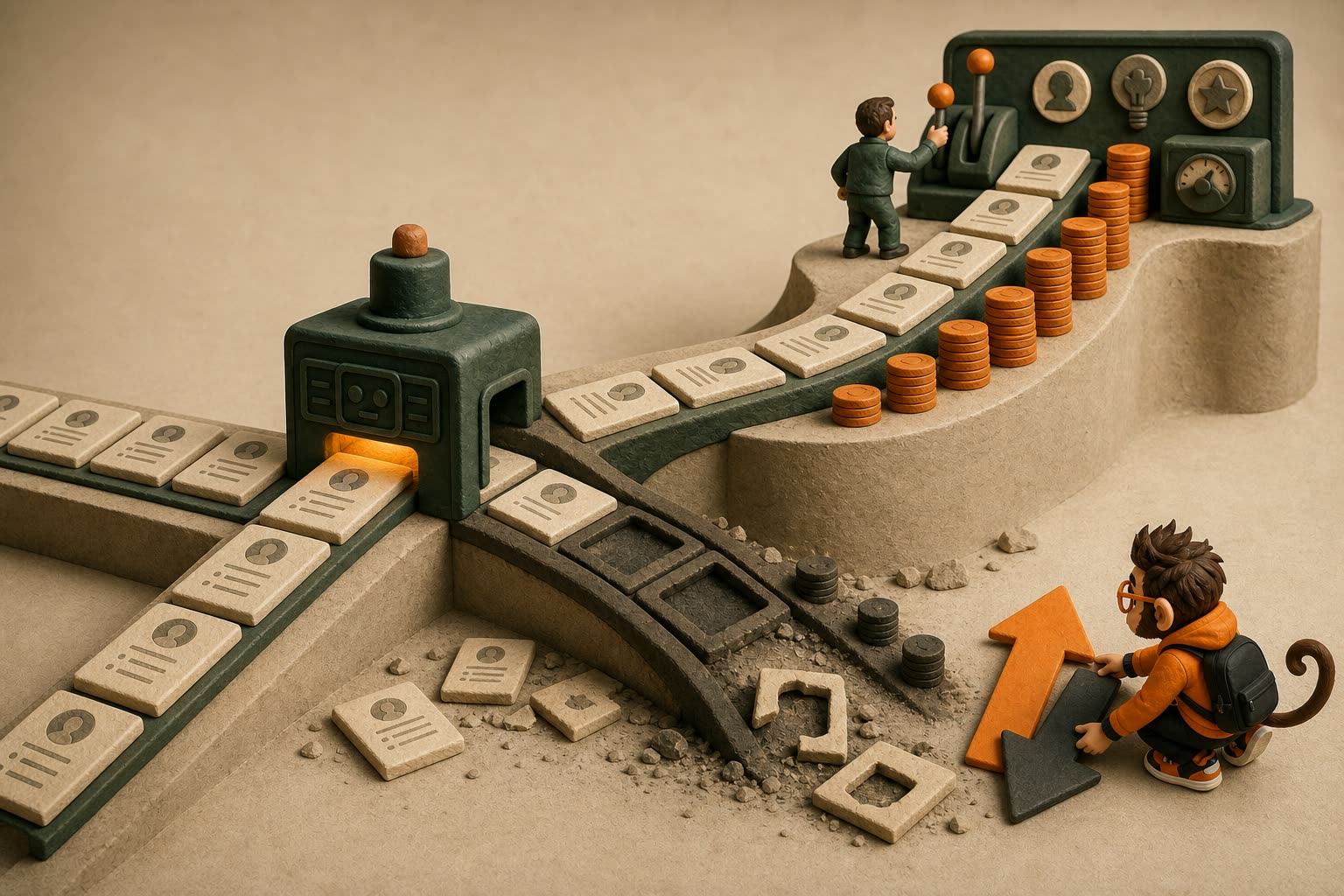
The automation effect on wages isn't mass unemployment. It's a sorting machine. Demand is rising at both ends of the skill ladder and falling out of the middle. The people who win aren't the ones who out-waited the technology. They're the ones who moved toward an end. The middle is the most dangerous place to stand still.
Most people ask the wrong question. They ask "will a machine take my job?" The honest answer for almost everyone is no, not directly, not soon. Unemployment can stay low while entire job families quietly hollow out around you. The question that actually predicts your next ten years is different: where are you on the curve, and which way are you drifting?
What is actually happening to jobs, in one shape?
Picture the labor market as a U. High-skill work on the left, low-skill work on the right, and the broad middle sagging between them. It's the same shape playing out inside single fields, where the 10,000 engineering jobs form a barbell, not a ladder. For four decades that middle has been emptying out. Economists call it job polarization, and the evidence runs deep. The original work showed that the shift away from routine tasks can explain roughly 60% of the relative demand shift favoring college labor between 1970 and 1998. Later work tracked it across hundreds of local U.S. labor markets: the places most loaded with routine tasks adopted technology fastest, pushed workers into service jobs, and saw wage growth only at the tails of the distribution.
Here's the part that should change how you think about your own career. New work keeps appearing. The majority of current U.S. employment sits in new job specialties introduced after 1940. The catch is where that new work lands. Before 1980 it filled the middle: production lines, clerical desks. Since 1980 it clusters at the high-paid professional end and, secondarily, the low-paid service end. The ladder didn't get longer. The middle rungs got sawn off.
Which jobs are in the disappearing middle?
The middle is where a task is routine enough to codify but the role was never pointed toward either edge of the curve. That's the trap. Look at what's projected to shrink.
| Role | Trajectory | Why |
|---|---|---|
| Bank tellers | -13% by 2034 (BLS) | Online banking killed branch growth; fewer branches, fewer tellers per branch |
| Bookkeeping and accounting clerks | -6% from ~1.6M jobs (BLS) | Software, then AI, ate the data-entry and reconciliation layer |
| Data entry clerks, postal clerks, cashiers, admin assistants | Fastest-declining roles globally | WEF expects 92M roles displaced by 2030 |
The World Economic Forum projects 170 million new roles and 92 million displaced by 2030, a net gain of 78 million. Net positive. That's the headline people quote to feel calm. It hides the churn underneath: around 40% of employers expect to reduce their workforce where AI can automate tasks, and 39% of the skills your job needs today are expected to change by 2030. A net gain across the economy is no comfort if your specific role is in the displaced column.
What's actually growing, and why is it growing at the ends?
Demand is rising on both edges of the U for opposite reasons.
On the high end, computer and mathematical occupations are projected to grow 10.1% through 2034. AI and data processing alone are expected to create 11 million roles even as they replace 9 million. These jobs survive because the work is judgment, novel problem-solving, and accountability. AI makes the person doing them faster. It doesn't replace them.
On the low end, the growth is physical and relational. Healthcare support is projected to grow 12.4%, and home health and personal-care aides are projected to add more absolute jobs than any other U.S. occupation. You can't automate sitting with a frail person, reading their face, and helping them stand. Presence is the moat.
Same education tier, opposite fate. A hospital billing coordinator does clerical, screen-based, codifiable work that insurance AI and automation tools are steadily absorbing. A home health aide does work that is irreducibly human. The difference isn't credentials. It's task structure: one is pattern-matching at scale, the other can't be done from a server rack.
Why does the same domain produce winners and losers?
Look inside a single field and the split gets sharp. Pick one trade-off and watch it play out three ways.
Weak position: the bookkeeping clerk. The work is entering numbers and reconciling accounts. QuickBooks chipped at it; AI finished the job. BLS sees the role shrinking 6% off a 1.6-million-job base.
Strong position: the FP&A analyst. Same numbers, different job. This person reads the financial signal, advises on strategy, and turns a spreadsheet into a decision a CEO can act on. The skill gap between the two isn't accounting. It's judgment and communication. That gap is the whole story.
Now the version that should worry anyone early in their career. Stanford's Digital Economy Lab found that employment for 22-to-25-year-old software developers fell about 20% from late 2022 to mid-2025, while older developers in the same occupation held steady. Across the most AI-exposed roles, early-career workers saw a 16% relative employment decline, concentrated in jobs where AI automates rather than assists. The bottom rung of the ladder, the code-generation grunt work that junior engineers used to cut their teeth on, is getting absorbed. This is why AI is hollowing out the bottom rung specifically, not mid-career, and that breaks the whole ladder behind it. The senior engineer who directs the AI, owns the architecture, and signs off on the risk is complemented, not replaced. The trade-off is brutal and new: the very tasks that used to train you into the high end are the ones disappearing first.
Isn't "just move to the high end" the obvious answer?
It's the obvious answer, and it's getting harder to pull off. Be honest about the cost.
The college wage premium, the extra you earn for a degree, peaked near 79% in the mid-2010s and slipped to about 75% by 2022. It's no longer rising. The supply of degree-holders caught up with demand, so the premium is concentrating in narrow high-skill fields like AI, data, and specialized medicine rather than spreading across every white-collar job. "Get a degree and you're safe" stopped being true once college shifted from a ticket to a toll booth.
There's a harder catch, named by economists who study this: not all automation pays off. When a machine displaces a worker without making the surviving work much more productive, the worker loses twice. The job goes, and there's no productivity dividend to lift wages elsewhere. It shows up in the numbers. Real wages for non-college U.S. workers have grown only about 20% since the 1980s, less than half the growth in overall productivity. The gains from the machines didn't reach them. So "move up" is real advice, but it's not a guarantee, and the staircase is steeper than it looks. Policy, bargaining power, and where you sit geographically all shape whether the hollowing middle turns into rising inequality or not. Automation creates the opening. It doesn't decide the outcome alone.
And if you're reading this from India or another developing economy, the map is different again. A 2025 comparison of India and the U.S. found India faces a double exposure: more workers already sit in low-skill, high-automation-risk roles, and AI-preparedness scores run lower. The clean U-shape of rich economies assumes you can reposition toward either edge. Where the low-skill service end is already saturated and the upskilling infrastructure is thin, the middle can hollow out with no obvious edge to run to. The honest version of this advice has to hold that.
What to do now
Stop asking whether automation will reach you. Start mapping your position.
-
Audit your role's routine-task intensity. Write down what you did last week. Circle every task that is codifiable: rule-based, repeatable, the same inputs producing the same outputs. The higher that share, the closer you are to the eroding middle. This is the single most honest signal you have.
-
Pick an edge and start moving. If your judgment, novel problem-solving, and the trust people place in you are the core of your work, you're already pointed at the high end. Deepen it. If the high end is too far a reach right now, a human-intensive role grounded in physical presence and relationship buys you durable ground while you build toward higher ground later. Either edge beats the middle.
-
Don't wait for the cut. The career stall that becomes a permanent step-down is the one where someone stayed put, assumed the ground was solid, and got moved while standing still. Consistency beats intensity here. You don't need a heroic reinvention. You need a deliberate direction and small repeated moves toward it, starting this quarter.
The middle is not a neutral place to rest. It's the highest-risk position on the board. The winners aren't smarter or luckier. They picked an end and walked toward it before the floor gave way.
Want to know which way your role is drifting on the curve, and the closest viable edge to move toward? Tell me what you do on WhatsApp and I'll map your routine-task exposure with you, then we'll build the first move. That's what I'm here for.
Related reading
Tech Job Market 2026: The Engineering Jobs Are a Barbell, Not a Ladder
ML engineer postings are up 59% while web and mobile dev roles are down 60%+. The tech job market in 2026 is a barbell: find your end and where to walk.
AI Doesn't Take Jobs. It Takes Tasks. That's Why Your Whole Role Won't Vanish at Once.
Will AI automate your entire job? Only ~4% of jobs use AI for 75%+ of tasks. Jobs are bundles of tasks, and AI takes some. Learn to read your own bundle.
AI and Entry-Level Jobs: Hollowing Out the Bottom Rung Breaks the Whole Ladder
New-grad role starts at big tech fell 50% from 2019 to 2024. AI is cutting entry level jobs by not backfilling them. Here's what breaks, and how to climb.
Will AI Replace Jobs? Mostly Not. The Person Using It Might.
Will AI replace jobs? The WEF projects 170M jobs created and 92M displaced by 2030. The real threat is the peer who uses AI. Here's who is actually exposed.