
Will AI Replace Jobs? Mostly Not. The Person Using It Might.
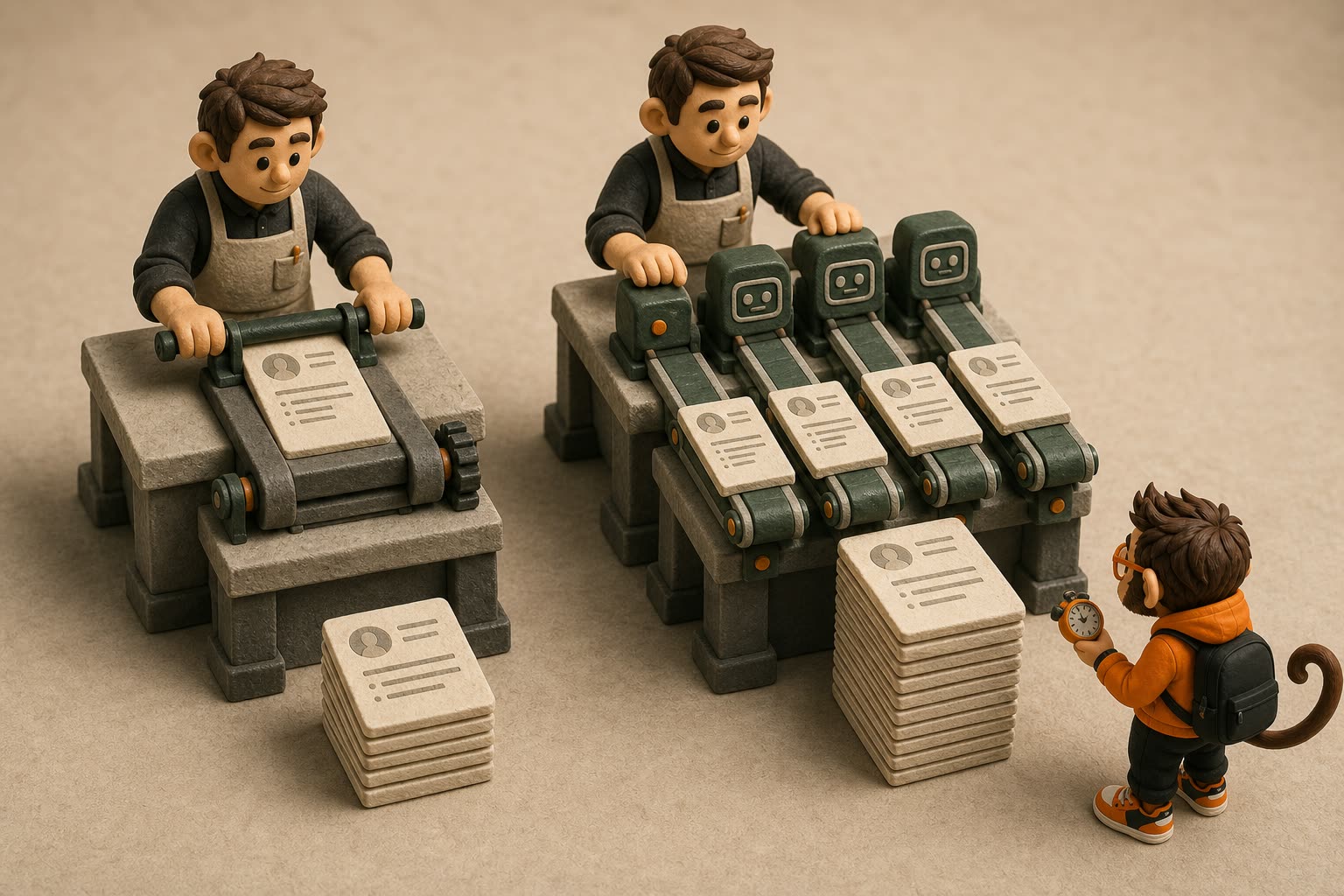
Will AI replace jobs? A few, yes, but far fewer than the headlines suggest, and mostly not yours as a whole. The serious research keeps landing in the same place: AI takes over tasks inside a role and rarely the entire role. The real threat is quieter and more personal. It's the person in your exact seat who hands the right half of the work to a machine and gets noticeably more done than you.
Here's who is most and least exposed, according to the primary sources:
| Exposure | Roles and tasks | What the data says |
|---|---|---|
| Highest (shrinking) | Postal, bank teller, data entry, cashier and ticket clerks; administrative assistants | Top of the World Economic Forum's fastest-declining list for 2025-2030 |
| High (slow decline) | Customer service representatives, medical transcriptionists, claims adjusters | BLS projects declines of 4.4% to 5.0% through 2033, partly from AI |
| Exposed but growing | Software developers, lawyers, personal financial advisors | BLS still projects growth: 17.9%, 5.2% and 17.1% |
| Lowest (growing fast) | Farmworkers, delivery drivers, construction, nursing, social work, teaching | WEF's largest absolute growth comes from frontline and care roles |
| Fastest-growing (percent) | Big data, fintech, AI and machine learning specialists | WEF's top three fastest-growing roles |
Here's what most people get wrong. They picture AI as a replacement event: one day the role exists, the next it's a model. That happens to a narrow band of clerical work. For almost everyone else, the role survives and splits in two. The execution layer (drafting, routine coding, standard tickets) gets cheap. The judgment layer (deciding what to build, judging whether the output is any good) gets more valuable. The cliché is annoying because it's right: AI won't take your job, but someone using AI might take your place in the queue for raises, promotions and offers.
Is AI really going to replace jobs?
Mostly no, at the level of whole jobs. At the level of tasks, it's already happening.
The ILO's 2023 global study found that only 5.5% of total employment in high-income countries is potentially exposed to the automating effects of generative AI, and about 0.4% in low-income countries. Its conclusion: generative AI is more likely to augment than destroy jobs, automating some tasks rather than taking over a role entirely.
The macro projection points the same way. Employers surveyed for the WEF Future of Jobs Report 2025 expect 170 million jobs to be created and 92 million displaced between 2025 and 2030, a net gain of 78 million. That's a net number, though, and nets hide people. The same report found that 41% of employers expect to downsize their workforce where AI can replicate the work.
Exposure is broad. Replacement is narrow. The IMF's 2024 staff discussion note estimates that almost 40% of global employment is exposed to AI, rising to about 60% of jobs in advanced economies. But exposure isn't a pink slip: the IMF splits exposed jobs into ones where AI likely complements the worker and ones where it may substitute, and in the US and UK high-exposure jobs divide roughly equally between the two.
And the aggregate damage so far looks small. A February 2026 issue brief from the International Center for Law & Economics, a privately funded policy think tank rather than a neutral statistical agency, concluded that most datasets find "little evidence of economywide job loss or wage decline" through 2024 and 2025, even though nearly 40% of US adults aged 18 to 64 reported using AI tools by late 2024. Treat it as one side's reading of the evidence, but note that it also finds the effects that do exist concentrated at entry level, which is where the next sections land.
What jobs will be gone by 2030?
None will vanish completely by 2030, but clerical jobs will shrink the most. The WEF's list of fastest-declining roles is dominated by them: postal service clerks, bank tellers, data entry clerks, cashiers and ticket clerks, administrative assistants and executive secretaries, and bookkeeping and payroll clerks. Graphic designers, claims adjusters, legal secretaries and telemarketers also make its top 15.
The ILO's breakdown explains why. Clerical work is the most exposed occupational group, with nearly a quarter of its tasks highly exposed and more than half at medium exposure. When most of a job is processing information in a standard format, the job itself thins out.
Notice the pattern, though. Even in the BLS projections, the declines are single digits over a decade, and BLS says its methods assume these changes tend to happen gradually. "Gone by 2030" is the wrong frame. "Fewer of them, doing different work" is the right one. Our deeper look at why AI automates tasks, not jobs shows how to read your own role task by task.
Which jobs will survive AI, and which will still exist in 10 years?
The ones whose core is physical work, care, or a judgment call someone has to own. Employers surveyed by the WEF expect the largest absolute growth in farmworkers, delivery drivers, construction workers, salespeople and food processing, with care roles like nursing and social work, and teaching, also growing strongly.
That's the low-exposure group. The more interesting group is exposed and still growing. BLS projects software developer employment to rise 17.9% from 2023 to 2033 even with AI coding tools, partly because cheaper software tends to raise demand for it. It projects personal financial advisors to grow 17.1% as the population ages and older clients make very limited use of robo-advisors, and lawyers to grow 5.2% because someone still has to review what the model wrote. Those are projections, not outcomes, but they show the agency's economists building AI in and still landing on growth.
Here's the part the headlines skip. Eloundou and colleagues at OpenAI and the University of Pennsylvania estimated that around 80% of the US workforce could have at least 10% of their tasks affected by large language models, and about 19% could see at least half affected, with higher-income jobs facing greater exposure. That's the inverse of earlier automation waves. Being well paid doesn't make you safe. Owning the decision does. Many of the new roles won't look new either; the jobs AI creates often arrive disguised as old ones.
Why is "someone using AI" the real threat?
Because the productivity gap between users and non-users is large, measured, and showing up inside the same job title.
Brynjolfsson, Li and Raymond studied an AI assistant rolled out to 5,179 customer support agents. Issues resolved per hour rose 14% on average, and 34% for novice and low-skilled workers, with minimal impact on the most experienced. In the Noy and Zhang experiment with 453 college-educated professionals, ChatGPT cut writing time by 40% and raised rated quality by 18%. Developers using GitHub Copilot finished a programming task 55.8% faster than a control group.
None of that is replacement. It's two people in the same seat, one pulling away. Picture two hypothetical HR generalists at the same company, each asked to write a performance improvement plan and a team policy update this week.
Weak version: Priya drafts both from scratch, carefully, the way she did five years ago. They're solid. They take most of her Tuesday. She mentions in her review that she's "exploring AI tools."
Strong version: Arjun has a model produce first drafts in minutes, then spends his time on the judgment: he spots that the policy contradicts a regional labor rule, rewrites the plan's goals so they're measurable, and uses the freed afternoon to fix the onboarding checklist nobody owned. His manager sees three outcomes, not two documents.
Nobody fired Priya. She's just running a slower career than she thinks. That's the shift toward judgment and conversation as the premium skills, and it compounds every week.
Is your job splitting in two, and which half are you in?
Probably yes. Every knowledge job is quietly separating into an execution layer and a judgment layer, and AI pushes them in opposite directions.
| Execution layer | Judgment layer | |
|---|---|---|
| What it is | Drafting, routine coding, standard tickets, formatting | Deciding what to build, judging quality, reading context, owning the call |
| What AI does to it | Compresses it: cheaper, faster, easier to copy | Augments it: harder to copy, more visible |
| Who's exposed | Anyone whose value is speed of output | Anyone whose value is the decision they make |
| The signal in the data | Novices gained 34% with AI help (NBER) | The most experienced agents saw minimal impact |
Read that last row carefully. The tool didn't make the best people better. It handed the least experienced a shortcut to competence, because the execution layer is exactly what a model can imitate. If your value is being fast at the doing, everyone just got faster. If your value is knowing what's worth doing, you just got more leverage.
Who does the "AI augments, it doesn't replace" story fail?
Young workers at the bottom rung, first and hardest. The augmentation story holds in aggregate. It does not hold for people trying to get in.
The Stanford Digital Economy Lab's "Canaries in the Coal Mine" paper by Brynjolfsson, Chandar and Chen, revised in August 2026 with data through June 2026, finds that employment of workers aged 22 to 25 in AI-exposed occupations now stands 19% below where it would be had it kept pace with less-exposed peers, while experienced workers show no comparable gap. The decline runs mostly through reduced hiring, not layoffs. The declines concentrate in occupations where AI mainly substitutes for human tasks. Where it mainly complements workers, employment is flat or rising.
That's the uncomfortable part. Judgment is built by doing the execution work badly, then better, under someone who corrects you. If AI absorbs the work that used to justify hiring a junior, the on-ramp to the judgment layer narrows. We go deeper on why entry-level is the AI casualty, not mid-career. A positive net job count in 2030 does nothing for the graduate who can't land a first role today.
Two more honest caveats. The productivity studies are short and clean: Noy and Zhang used 20-to-30-minute writing tasks, and Copilot was one controlled programming problem, so real-world gains may be smaller. And the projections (WEF, BLS, IMF) are projections, built on employer surveys and historical patterns that a fast technology can break. Hold the exact numbers loosely. The direction across all of them is consistent: tasks first, whole jobs rarely, entry level hit first.
What to do now
- Audit your week into two columns. For five working days, sort every task into execution or judgment. If most of your time sits in execution, that isn't a moral failing. It's a market signal about which half of your role is compressing.
- Hand one execution task to AI this week. Pick something you do repeatedly (a report, a first draft, a test suite) and redesign it with a model doing the first pass. Measure the time before and after.
- Spend the saved time on a judgment task nobody owns. The gain only counts if it turns into visible decisions, not more of the same output.
- Turn it into proof, not a buzzword. Listing tools on your profile means very little now. One before-and-after with a number on it ("cut weekly reporting from four hours to one") says more.
- Check which direction your role is moving. If your title sits in the WEF or BLS declining groups, look at adjacent roles on our job search and note which skills keep showing up in the listings that are growing.
Not sure which half of your job AI is already eating? Tell Praxy your role and what a normal week looks like on WhatsApp. I'll help you sort your tasks into execution and judgment, pick the first one to hand to AI, and turn the result into a line your manager or next interviewer will actually remember.
Related reading
AI and Entry-Level Jobs: Hollowing Out the Bottom Rung Breaks the Whole Ladder
New-grad role starts at big tech fell 50% from 2019 to 2024. AI is cutting entry level jobs by not backfilling them. Here's what breaks, and how to climb.
AI Doesn't Take Jobs. It Takes Tasks. That's Why Your Whole Role Won't Vanish at Once.
Will AI automate your entire job? Only ~4% of jobs use AI for 75%+ of tasks. Jobs are bundles of tasks, and AI takes some. Learn to read your own bundle.
AI Is Creating Jobs. They're Just Disguised as Old Ones.
New jobs created by AI mostly wear old titles. How to spot them, claim the augmented version of your role, and stop waiting for a new posting.
Is a Cover Letter Necessary? Only for the Person Who Decides
Is a cover letter necessary? Recruiters mostly skip it, but 94% of hiring managers say it sways who gets interviewed. Here's when to send one, and when not.